


Introduction
Welcome back to the Wild Globalization Project. Today we’re into the Wild Economy, Part 2, The Knowledge Economy.
Hang on – it’s only getting wilder…!
Wild Economy, Part 1 asked, “How did this 19th-21st century global economy get going…?” We bushwhacked through 10,000 years of the agricultural economy, the Dark Ages, coming out in the Western Enlightenment, and its Industrial Revolutions.
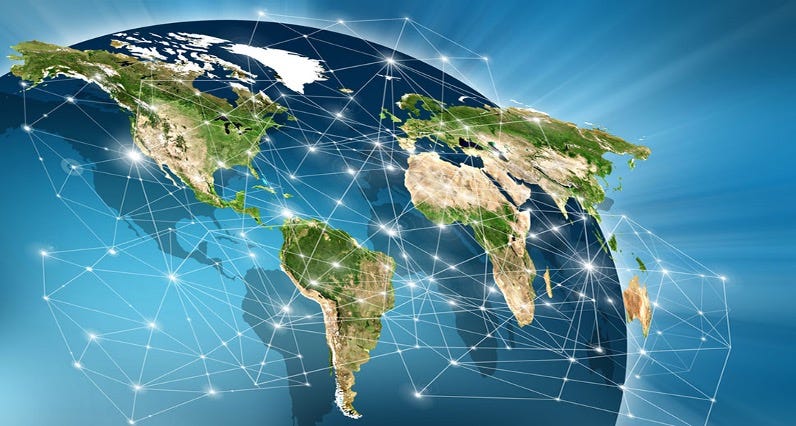
In Part 2 we’re asking “How did the last 250 years – just 10 generations of maybe 10,000 Homo sapien generations that have ever lived – how did all this launch us into this new 21st century “knowledge” version of global civilization?
Here’s our claim: “The global knowledge economy is evolutionary…and evolution is wild…!”
Global Civilization – a black box…a quantum entanglement…a wild “big wave!
The Wild Globalization Project is studying how civilization's life-world works like a "BLACK BOX" – modern physics calls this a “quantum entanglement.”
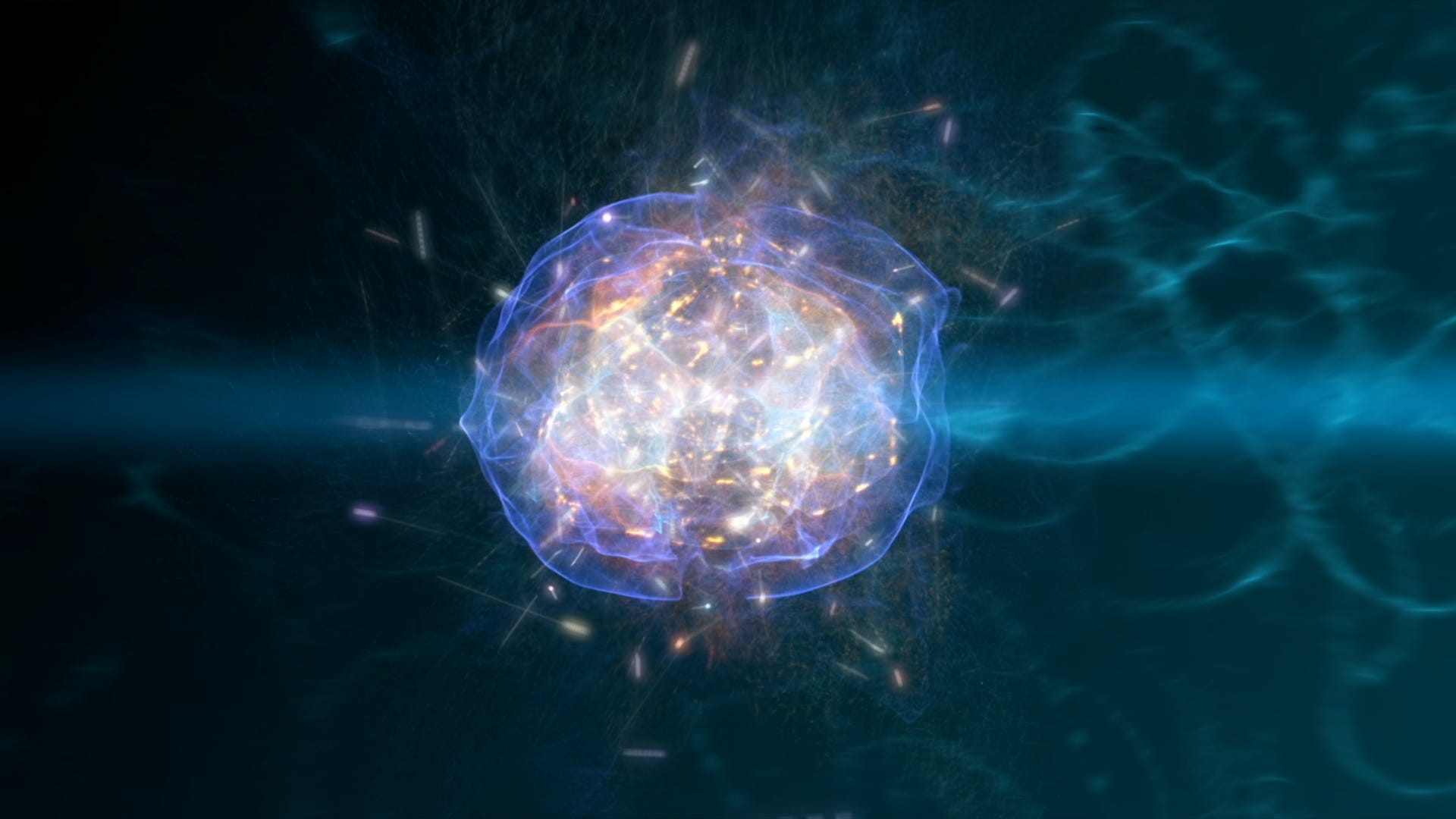
Imagine many rivers flowing, crashing, together: today’s wild economy river, but then a wild ecology…demographics… technology…then a governance…and a wild wealth river – all inter-, over-, and under-flowing the others, each with its source and power, yet at once a singular, entangled momentum that constantly tears down and builds up the life-world – what Joseph Schumpeter called “…the incessant gale of creative destruction.” We’re saying that it’s from these entanglements that the spontaneously emerging orders of life appear.”
But then…wait a minute…there goes our human again, and today she’s surfing a big wave on a surfboard…! Where did she come from…?
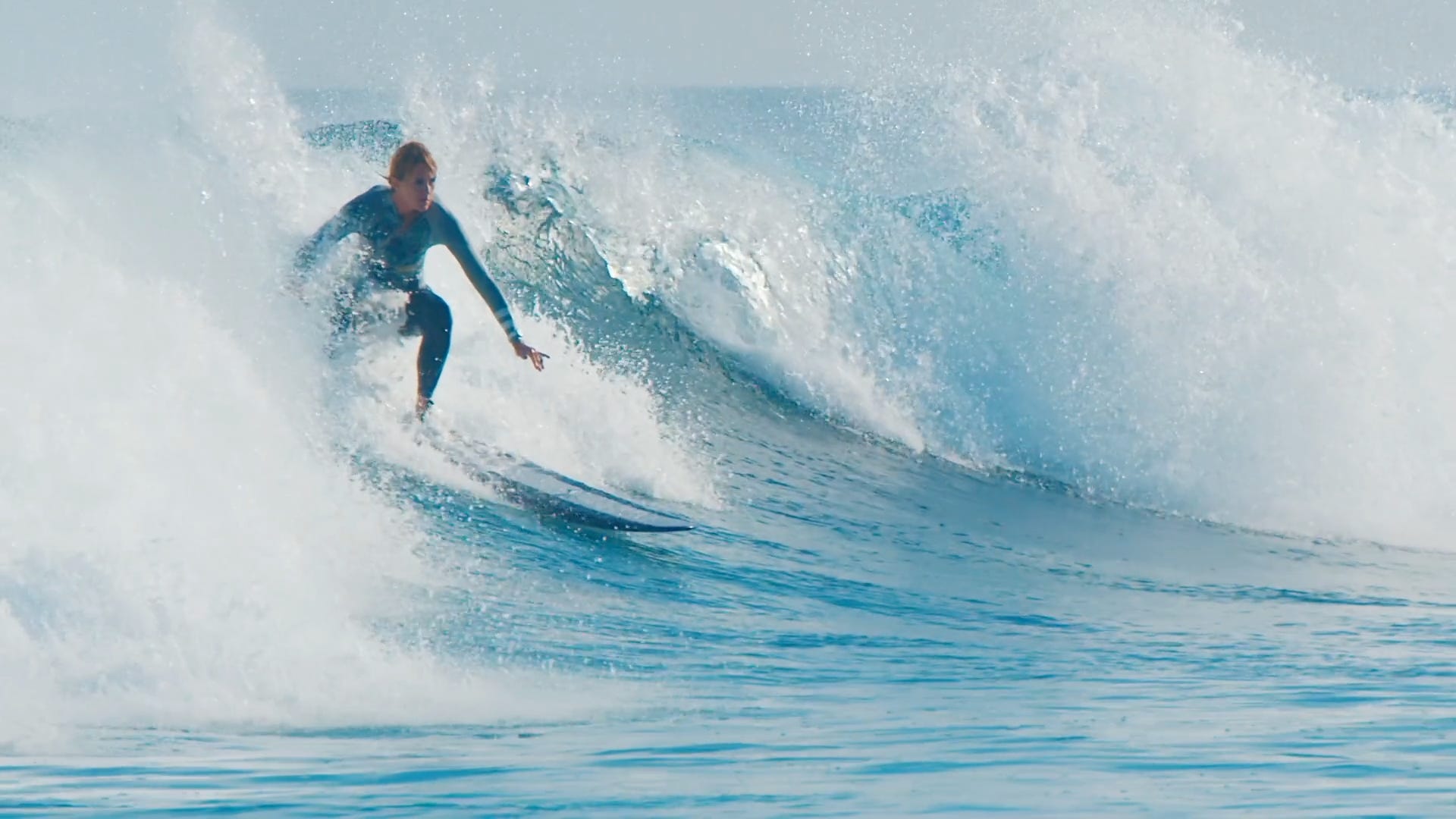
She’s showing us how humans have not emerged “from the wild.” We are wild Homo sapien. The wild is happening right here and now, it’s carrying us but we’re also causing it! “Hyper-natural” humans have been globalizing the planet for 250,000 years.
To get here we’ve relied on two unique abilities:
First, we can think critically, we learn and solve problems, we gather and intelligently deploy KNOWLEDGE. OR NOT!
Second, we can love and care for each other and the planet – humans make extraordinary sacrifices to protect their loved ones and planet Earth. OR NOT!
The 21st century continues to advance knowledge, now into artificial intelligence, “A.I.” Human evolution is the evolution of human knowledge. Human economy is about the advance of knowledge. But global civilization advances ahead of human control and therefore ahead of our ethical concerns and conscience. This advance has only accelerated since the Western Enlightenment and the Scientific Revolution.
Intelligence and caring for one another and the planet are modernity’s great challenges.
Like the surfer’s “big wave,” Wild Globalization is wondering, “How the heck do we ride the 21st century’s big waves?”
The Wild Information >> Knowledge >> Wisdom Economy – Where From…?
Here’s a quick recap of how our earlier talks got us here:
WILD ECOLOGY…
“Economy” and “Ecology” (both from the Greek word “oikos”) started 4.55 billion years ago…Earth’s energy “orders”…its big ice, mega-volcanoes, geomagnetic storms…the Universe’s “dark matter…” Homo sapien has been around for 5 seconds* of a 24 hour day.
*250,000 Homo sapien-span years / 4,550,000,000 Earth-span years = 0.000055] X [(24 hours X 60 minutes X 60 seconds = 86,400 seconds)] = 4.75 seconds.
WILD DEMOGRAPHICS…
Hyper-natural humans, hanging on by the “skin of our teeth”…almost vanishing in the ice and fires…now eight billion of us and on our way to ten…gathering and learning …we are the “knowledge species” that survived and now thrives…
WILD TECHNOLOGY…
The “unconstrained human imagination”…atlatls to nuclear…hunter-gatherers to farmers to scientists and astronauts…Fogel’s “techno-physio-evolution”…
WILD ECONOMY…
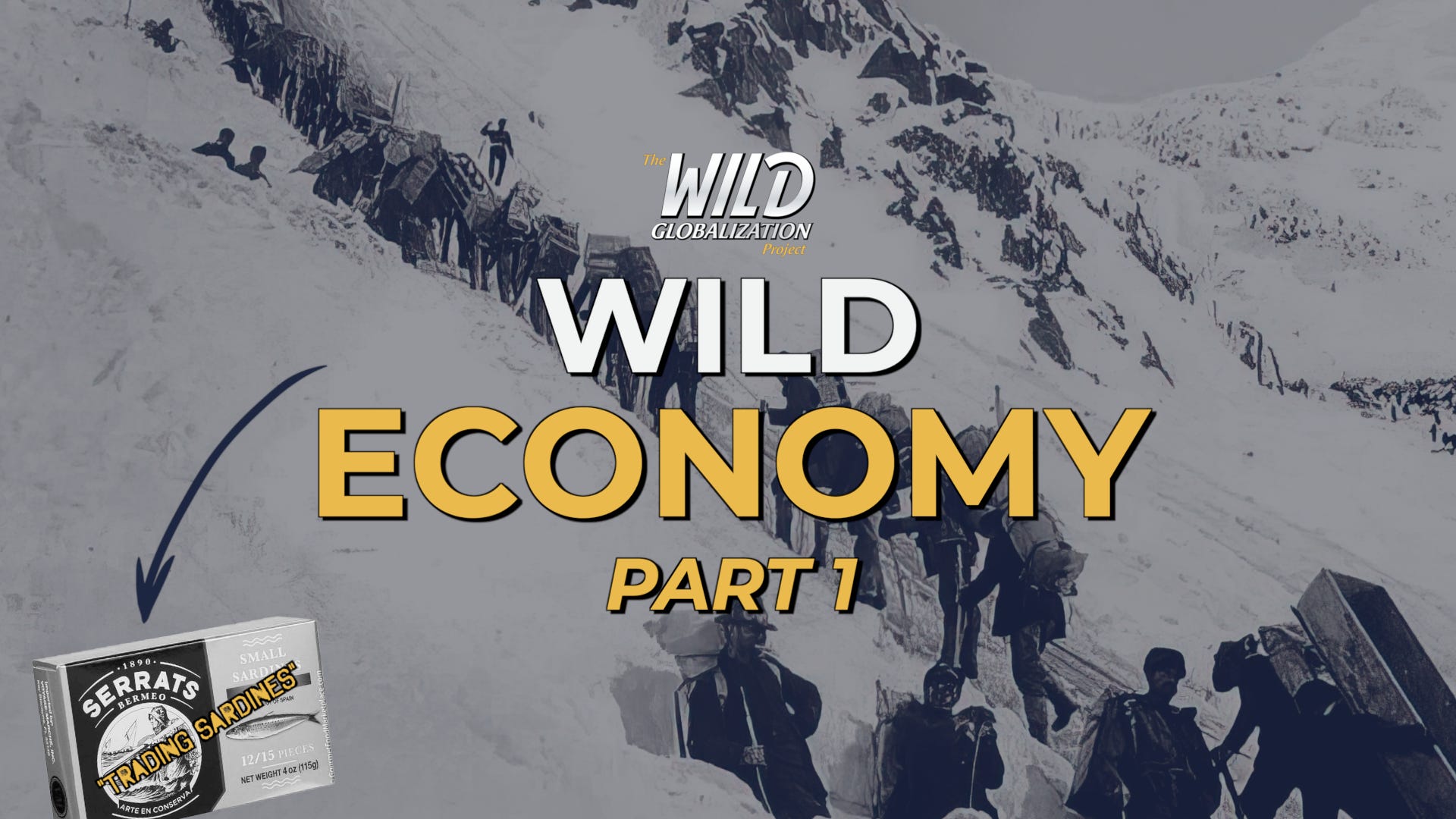
The progression through scarce resources >> learning & innovation >> excess production >> excess reserves >> “seed” capital >> entrepreneurs >> markets >> consumers. The Modern Age’s revolutions – Science, Industry, Digital, now Cloud A. I.
Like every other creature in Earth’s ecology, Homo sapien started with “scarce resources.” We innovated, got smarter, taught our kids. We settled down, grew and raised food rather than gathering and chasing it. We kept a little extra, a “reserve,” some “seed”-capital. In just the last 80 generations (2000 years), some humans, working and innovating freely mobilized markets >> entrepreneurs >> consumers. Then, in just the last 10 generations (250 years), free-thinkers and clever innovators dreamt up modern science and technology, and – whoosh! – it was off to the Moon…and soon, Mars!
What screams out here is “free thinking…learning…KNOWLEDGE”! How to freely imagine and make and do new things. THINGS THAT WORK! Even, as Beth Shapiro reminded us in Wild Demographics, Part 1:
“…our ancestors figured out how to break the rules. They learned to work together to overrule chance, to help others rather than allow those less fit among them to die. They learned to fashion their surroundings…They learned to direct evolution—to determine both their own evolutionary trajectories and those of the species with which they interacted…while paleoanthropologists still don’t fully understand where or when or how this happened, this is how we became different…from every other species that lives or has ever lived on Earth. This is what it means to be human.”
“Human economy” is the evolution of “knowledge.” Not just information…“knowledge.” But knowledge alone doesn’t advance civilization. That’s because knowledge can be used for the creative good, or for the most destructive and horrific evils.
No. Raw data and information, transformed into “knowledge,” requires, it begs, for “virtue,” for intelligent use.
Information is not Knowledge; Knowledge is not Wisdom; Wisdom – practical wisdom – whatever we mean by that, is the optimal expression of human economy. OR NOT!
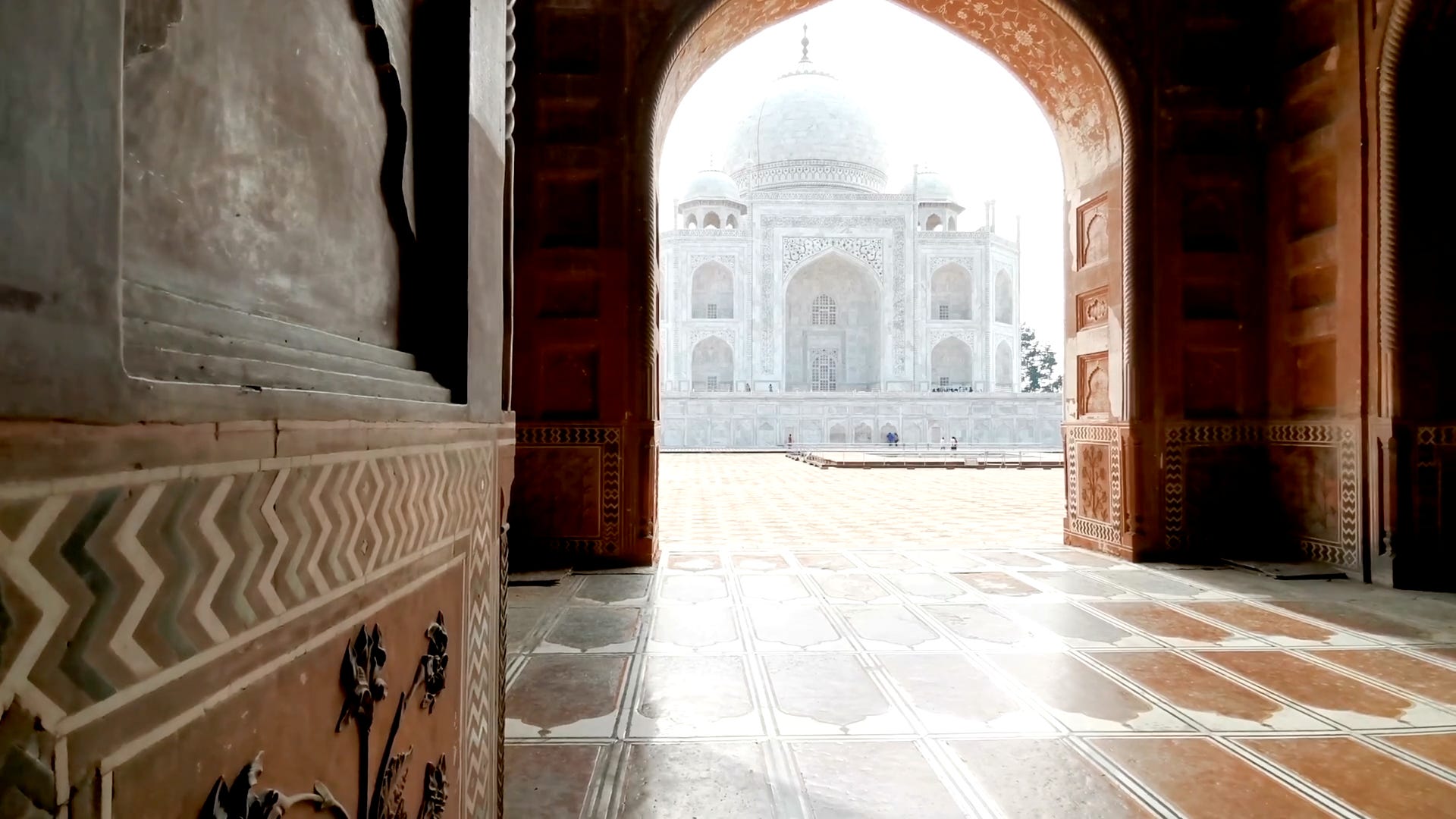
This new “information >> knowledge age” is really the most recent version of Thomas Sowell’s “knowledge economy” – to paraphrase him, “…the only thing that differentiates us today from our pre-historic ancestors is our ability to use what we’ve learned, our knowledge, to exploit identical resources – our deep ancestors had the same marble and stone to build the Taj or Notre Dame – but it was knowledge that built them. Knowledge advances human civilization…OR NOT!”
Thinking the Global Knowledge-Wisdom Economy
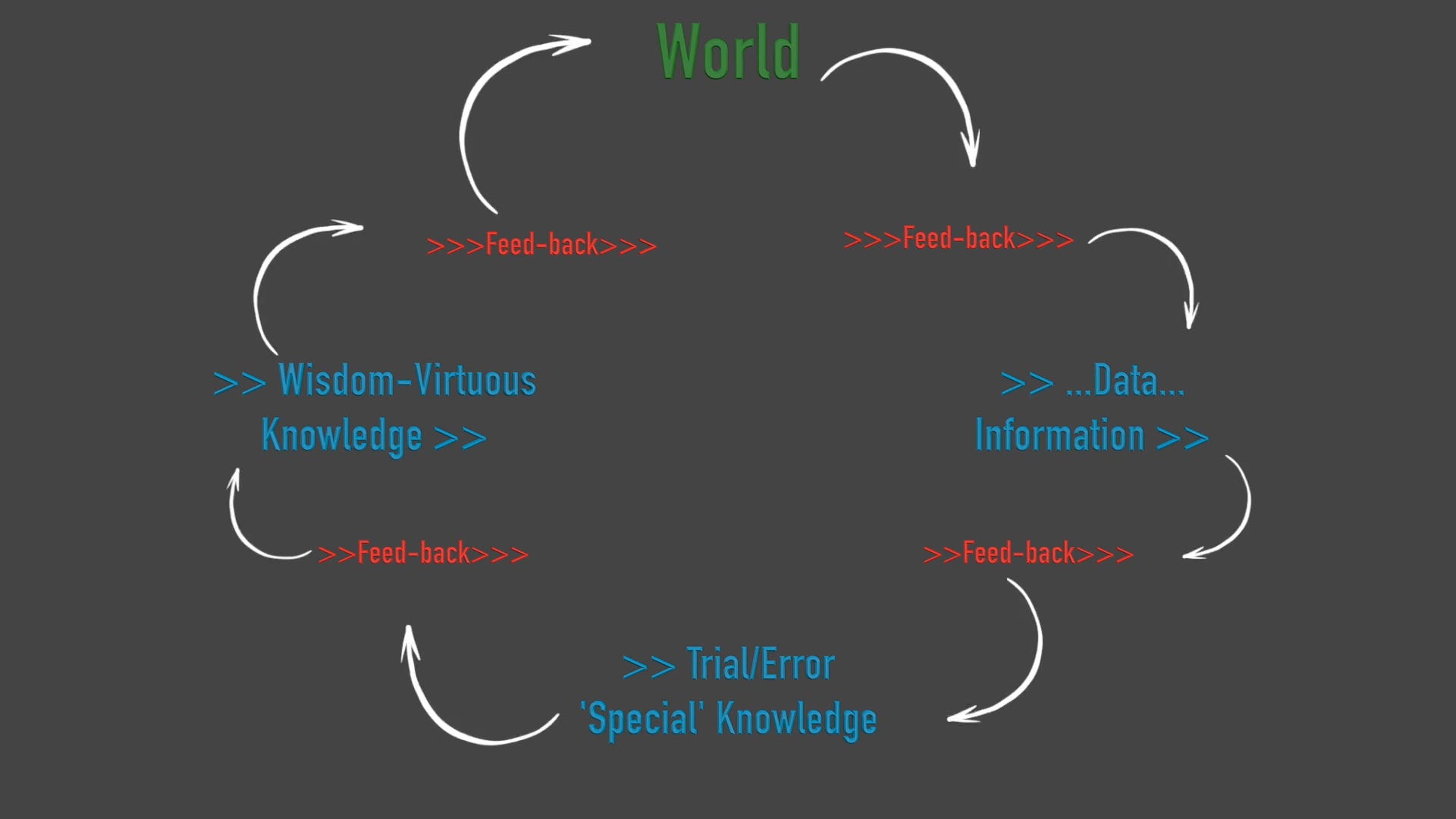
The Information >>> Knowledge >>> Wisdom Economy is “trial and error…and feed-back-looped,” from the get-go. Humans obsessively and passionately venture out, risk new things, get whomped on by saber-toothed tigers or stock market crashes, but then get up, re-think and get back at it. Knowledge learning might be visualized like this:
However, this new, 21st century knowledge, or “A.I.”, economy represents a quantum leap in human economic evolution.
Alvin and Heidi Toffler, in Revolutionary Wealth, describe ten factors to describe this emerging knowledge economy:
“Knowledge is non-rival”: unlike bananas or crude oil, knowledge is not scarce – using a Microsoft program doesn’t reduce its supply.
“Knowledge is intangible”: IBM learned from a bunch of Bill Gates hippies that computing was about the “software” not the “hardware;” the Taj and Notre Dame were built with knowledge not stone.
“Knowledge is non-linear”: Small discoveries can yield huge results – the Bell Labs astronomers were cleaning bird-poop off their radars when they discovered the Big Bang’s “cosmic background radiation.”
“Knowledge is relational”: knowledge only has meaning in relation to the accumulated “body” of all other knowledge.
“Knowledge mates with other knowledge”: so knowledge is promiscuous…it grows and multiplies.
“Knowledge can be compressed into signs and symbols”: the blueprints for the Taj or Notre Dame, or the Space Shuttle’s 2.5 million parts, can be packed into a tiny micro-chip, or a human brain.
“Knowledge is more portable than any other product”: once converted to “zero and one codes” or “language,” it can be distributed instantly to the person next door or 8 billion over the Internet.
“Knowledge can be stored in smaller and smaller spaces”: we can hold virtually all knowledge, operas and symphonies, artworks, literatures, scientific research, in our smartphoned hands.
“Knowledge can be explicit or implicit, expressed or not expressed”: There is no implicit truck or barrel of oil.
“Knowledge is hard to bottle up. It spreads”: Knowledge, once discovered or revealed, can be replicated, copied. Now we’re even asking if “A.I. can think on its own?”
Alvin & Heidi Toffler, Revolutionary Wealth
Louis-Vincent Gave, in A Roadmap for Troubling Times¸ sums up the shocking implications of Toffler’s vision here:
“…wealth creation is, for the first time in history, the result of something which is in unlimited supply, and which has a marginal cost of zero. This puts into question the whole intellectual framework of economics…what’s the use of marginal analysis when the marginal cost is zero? The notion of markets is changing in front of our eyes [because] a market in which the supply is infinite is not a market. Neither the economists, nor the accountants, nor the analysts [GB: or the philosophers] have done enough work to understand the implications. What we do know is that the tools to manage a knowledge-based economy [GB: really, a global civilization”] will be profoundly different than those necessary to manage an industrial-based economy [GB: “…or any civilization in human history”]. It’s simply not about allocating scarcity anymore?”
What they’re saying is that we’ve gone from an economy where knowledge manages resources – like goats or crops or iron or steel or crude oil – to an economy where knowledge is the commodity – it’s now the goat or pig or barrel of oil!
Global Information-Knowledge-Wisdom Civilization
So caveat emptor – BUYER BEWARE! Knowledge and intelligence have always been the human way. But this is now a new ballgame that begs a re-look at how knowledge actually works in culture and civilization. So let’s add some wild globalization factors to the mix.
Knowledge is learned – if Beth Shapiro is correct, then learning and acquiring knowledge is what it means to “be” human. A child can thrive if they get knowledge, OR NOT! And not just learn, re-learn over a lifetime – think how things have changed and how you’ve had to learn and re-learn things. Education, learning, and persistent questioning and re-learning, are the keys.
Knowledge is cumulative – it’s been growing for thousands of years – Sir Isaac Newton said: “…I was able to see because I stood on the shoulders of giants…”; but the risk here is that, if you don’t have knowledge, you can’t compete, and knowledge will run you over like a Mack truck. Civilization is built on knowledge and education, OR NOT! It can quickly decline and fail without it.
Knowledge is all about feed-back! – it’s experimentation, observation, and constant re-thinking and correction. Apollo Moon flights were never exactly on course but were constantly self-correcting their flight using navigational feed-back. Knowledge can be, must be, corrected, improved, fine-tuned, or eliminated if it doesn’t work. Governments can’t figure this out.
Knowledge “creators” can change everything – Copernicus “re-set” the solar system; Einstein re-imagined energy; Hawking exposed “black holes” in the fabric of the universe; Oppenheimer’s team gave us the atomic bomb.
Knowledge is communal – Copernicus, Einstein, Hawking communicated and fed off the work of other thinkers; Oppenheimer’s team won the atomic race; knowledge lives in an education community. It can die there too – so how is America doing with K-12 education?
Knowledge advances ahead of our ability to anticipate, manage, and control its impacts – the Manhattan Project built the atomic bomb, but global governments can’t manage it 75 years later.
Knowledge spontaneously creates new orders but also tears down existing orders – steam engines destroyed sailmakers’ livelihoods; the smartphone is genius, but it’s morphing, even warping, the minds and souls of our children.
Knowledge transforms itself as it advances – Human intelligence starts with “data…information,” turns it into usable “knowledge,” and then deploys it intelligently, virtuously, OR NOT!
Knowledge makes modern human life risker, more vulnerable – can you make anything, grow or raise anything, that’s “supply-chained” to you from your grocery store?; hence, knowledge changes every day human nature as it advances.
Knowledge is “evolutionary” – it’s constantly exposed to “wild globalization” feedback – >> ecology >> demographics >> technology >> economy >> governance >> wealth.
Knowledge is built with “facts” and “data,” so it naturally fights with itself over what the data actually means – Michael Crichton says about science, “…if it’s consensus, it’s not science; if it’s science, it’s not consensus!”; Frederich Nietzsche, a century before Crichton, observed, “…there are no facts, only interpretations…”
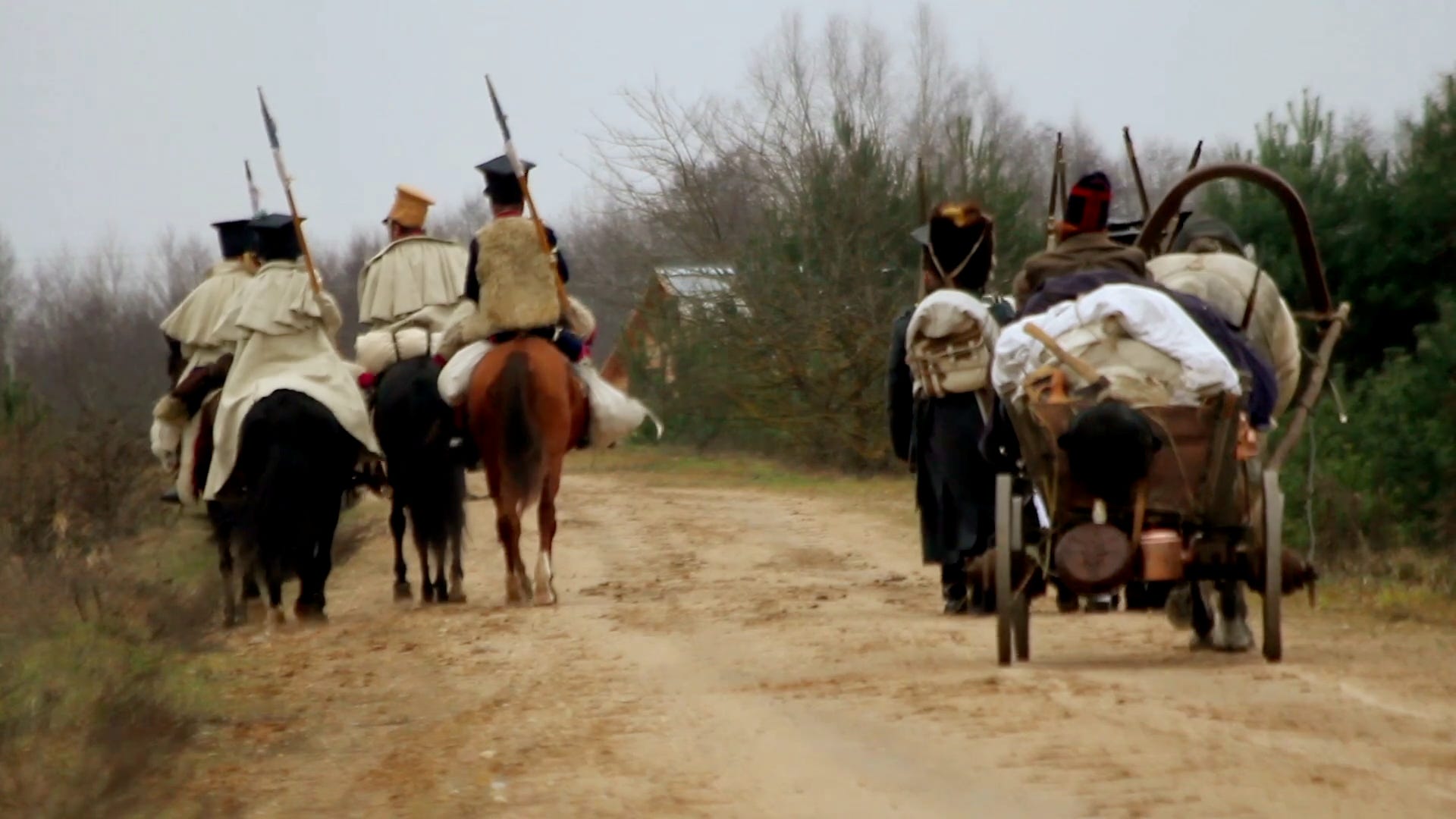
Vintage army goes on rural road Knowledge and “ideas are peaceful, but history is violent” [as tank commander Don “Wardaddy” Collier warned in the movie, Fury] – the American Civil War claimed 600,000 lives, first fighting over the “union,” OR NOT! But after the Emancipation Proclamation, the 600,000 were the final signers of that Proclamation – and, as well, our Declaration of Independence’s promise that “all ‘humans’ are created equal.” Their blood sanctified the very “idea” of America.
Knowledge is a “Black Swan” – Nassim Nicolas Taleb reminds us that, “We do not know what we will know;” entering World War II, who predicted Hiroshima and Nagasaki? Steve Jobs and Apple unleashed finger-tip knowledge and social media, but could they have known how their marvelous smartphone would threaten our kids?
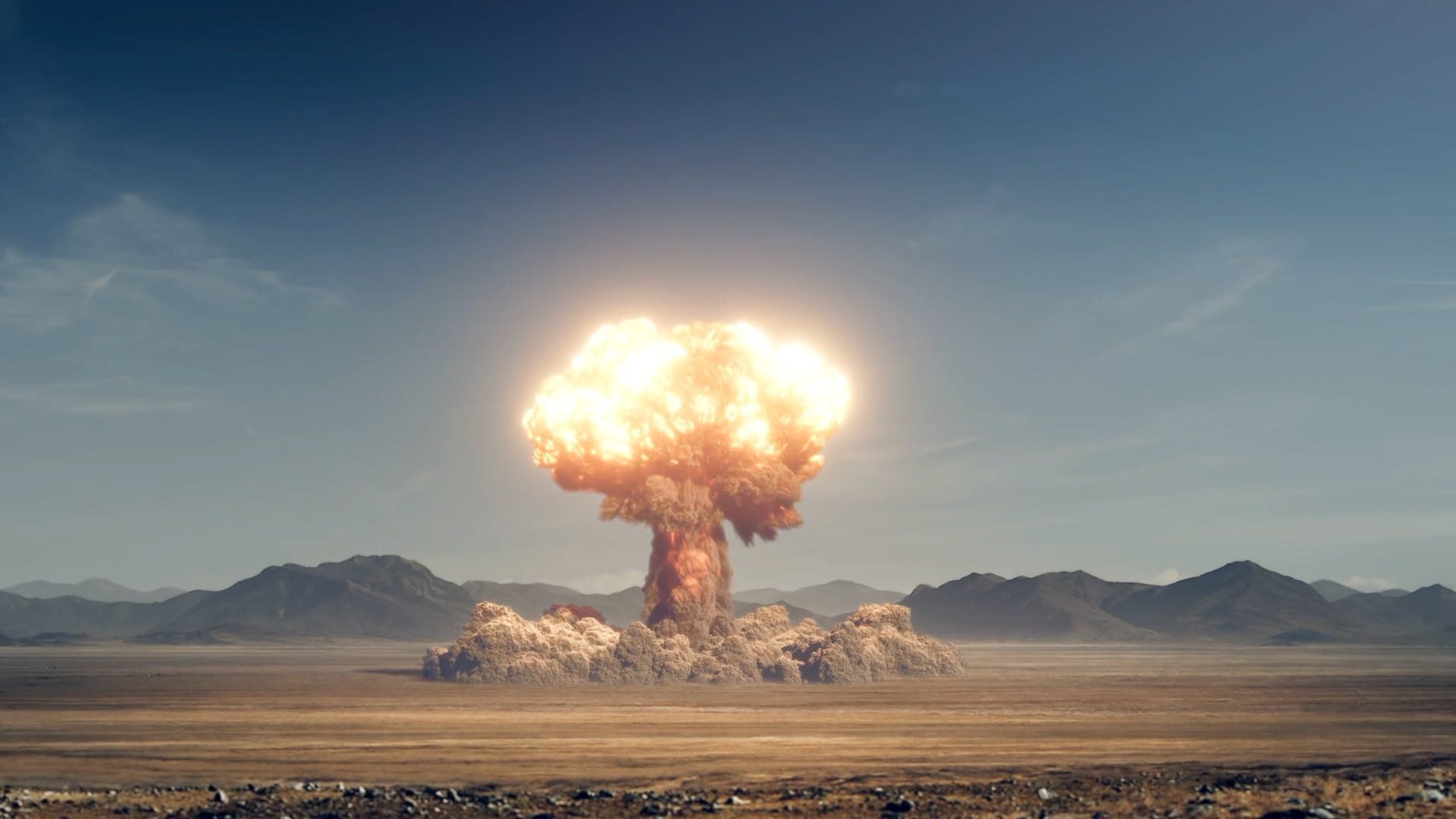
Huge nuclear bomb explosion with a mushroom cloud, weapon of mass destruction Knowledge of the future is wild, it’s vulnerable to the “butterfly effect” - to predict the future with mathematical accuracy, say,
“the trajectory of a billiard ball at the ninth impact, you need to know the gravitational pull of the person standing by the pool table; to predict the 56th impact, every single elementary particle in the universe needs to be included in your calculation.”
Taleb, The Black SwanKnowledge “knows” and can show us its limits, its boundaries; it’s inherently “wise.” - But we have to listen.
Knowledge has always “been there”: like every resource, knowledge has and is always potential, discoverable, available - like the Big Bang’s residual “cosmic radiation;” until it’s discovered, knowledge lives “in the “background” of human awareness.
Knowledge spreads out unevenly – it creates unfairness, inequality: if knowledge is the core human resource, then the more, or less, you have it says how well-off you are or can be. Is it money and capital, or knowledge as capital, that actually creates social inequality? SpaceX’s StarLink may be changing that by connecting everyone to the knowledge world.
Knowledge is incomplete without judgement, common sense, and practical application – Steve Jobs said: “Aspirational knowledge without implementation is hallucination.” A.I. might be able to provide “practical application” but can it also provide “common sense,” or “judgement,” or “conscience?”
Knowledge was “capital” before Marx’s “capitalism”; it still is: “seed” - grain was the first mortgage 3,000 years before money or capital. However, the real capital was not the seed, it was the knowledge of how to plant, grow, and harvest it that created value. A mountain of gold piled up in front of the Taj or Notre Dame didn’t build them – smart people built them.
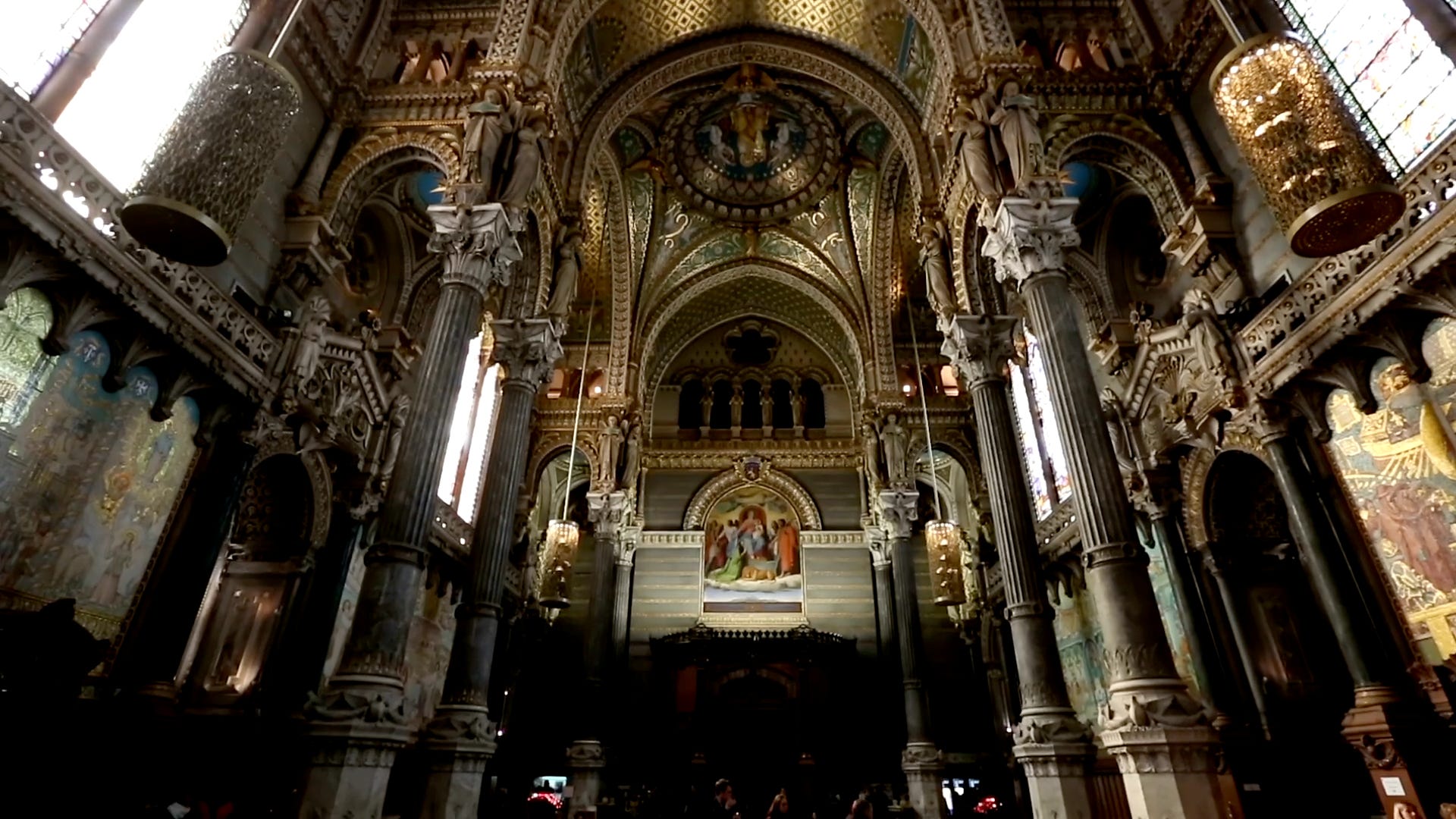
Lyon Notre-Dame de Fourviere Basilica Church France Knowledge is unconstrained – as the great 20th century theologian and philosopher, Bernard Lonergan, observed, knowledge is “…the full set of answers to the full set of questions…” – this was also his definition of the “divine.” The Greek philosopher, Heraclitus, calls this, “logos,” another word for “order.”
SUMMARY: All of these factors add up to what human economy is. Together, they tell us why human economy is wild, unpredictable, and advancing ahead of our ability to control it or apply it with full care and concern. Knowledge is the big wave that has always carried Homo sapien, the knowing creature. The knowledge economy is a quantum entanglement – it’s far more powerful and unpredictable than we can know. Human knowledge is nature’s “new natural” – a hyper-natural real. Human knowledge and discovery constantly breathe new opportunity but simultaneously new risk into civilization’s economies and ecologies. When it’s discovered, its impact is unconstrained until humans get it and hold it down, use it intelligently, wisely, OR NOT! All of the above belay only a “sense” of what “knowing” and “knowledge” constitute – the power or potential of knowledge and ideas are best perceived by walking through the Taj Mahal or Notre Dame Cathedral, or viewing the Mona Lisa, listening to a Mozart or Ravi Shankar composition, observing the Voyager satellite leave the solar system, or tragically and horrifically, by visiting Auschwitz. The knowledge-wisdom economy undermines and defies full description or final definition, but instead remains, simply, WILD…and in the 21st century A.I. economy, growing WILDER!
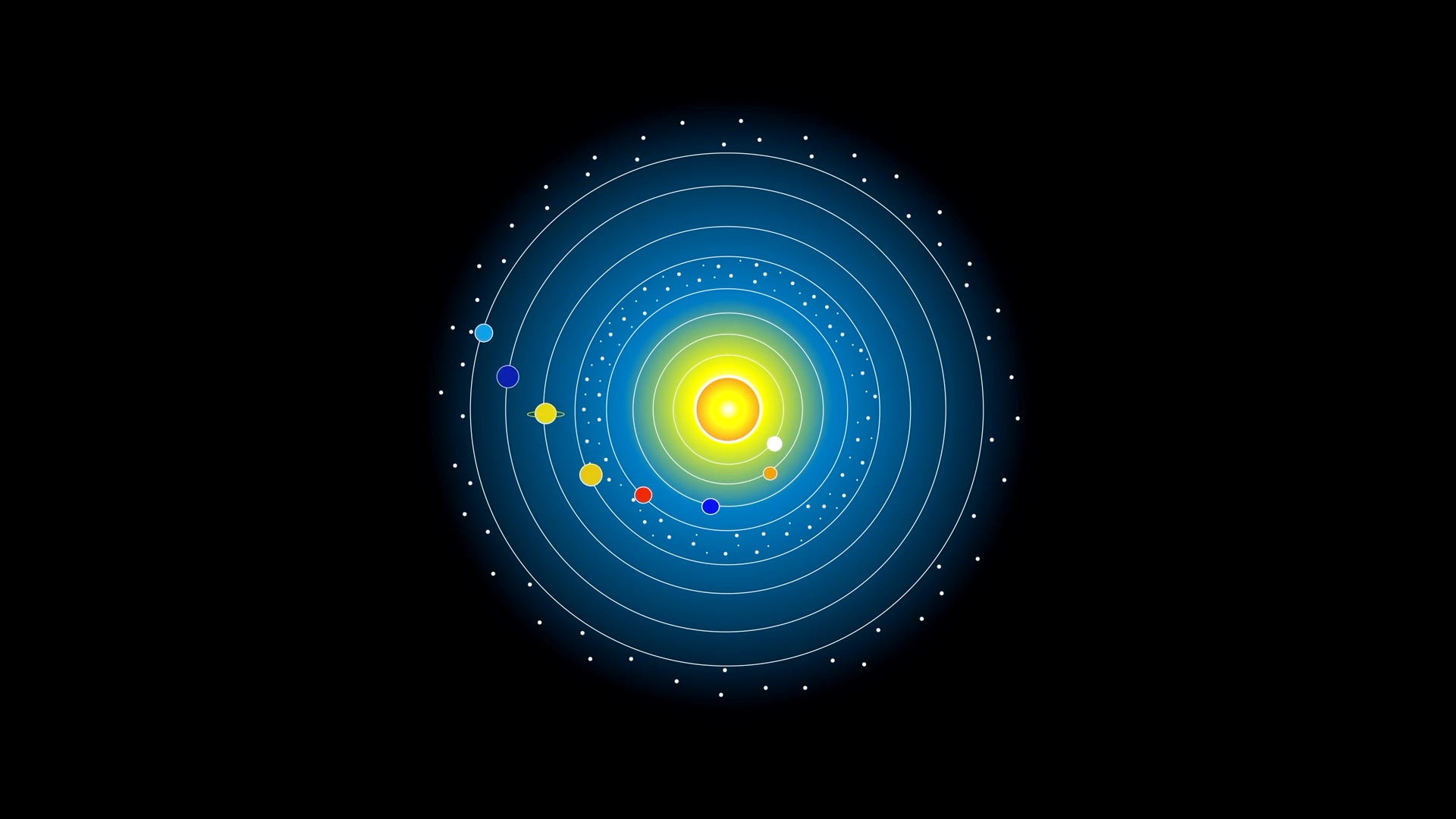
The Modern Age’s Wild, Roller-Coaster “Knowledge” Economy
If the human story is evolutionary, as we suggest, and if knowledge is our lifeblood, then how can we re-assess say, the last 250 years – the recent trek into “modernity?” And what might that mean for the 21st century going forward?
The Great Divergence and The Greater Convergence
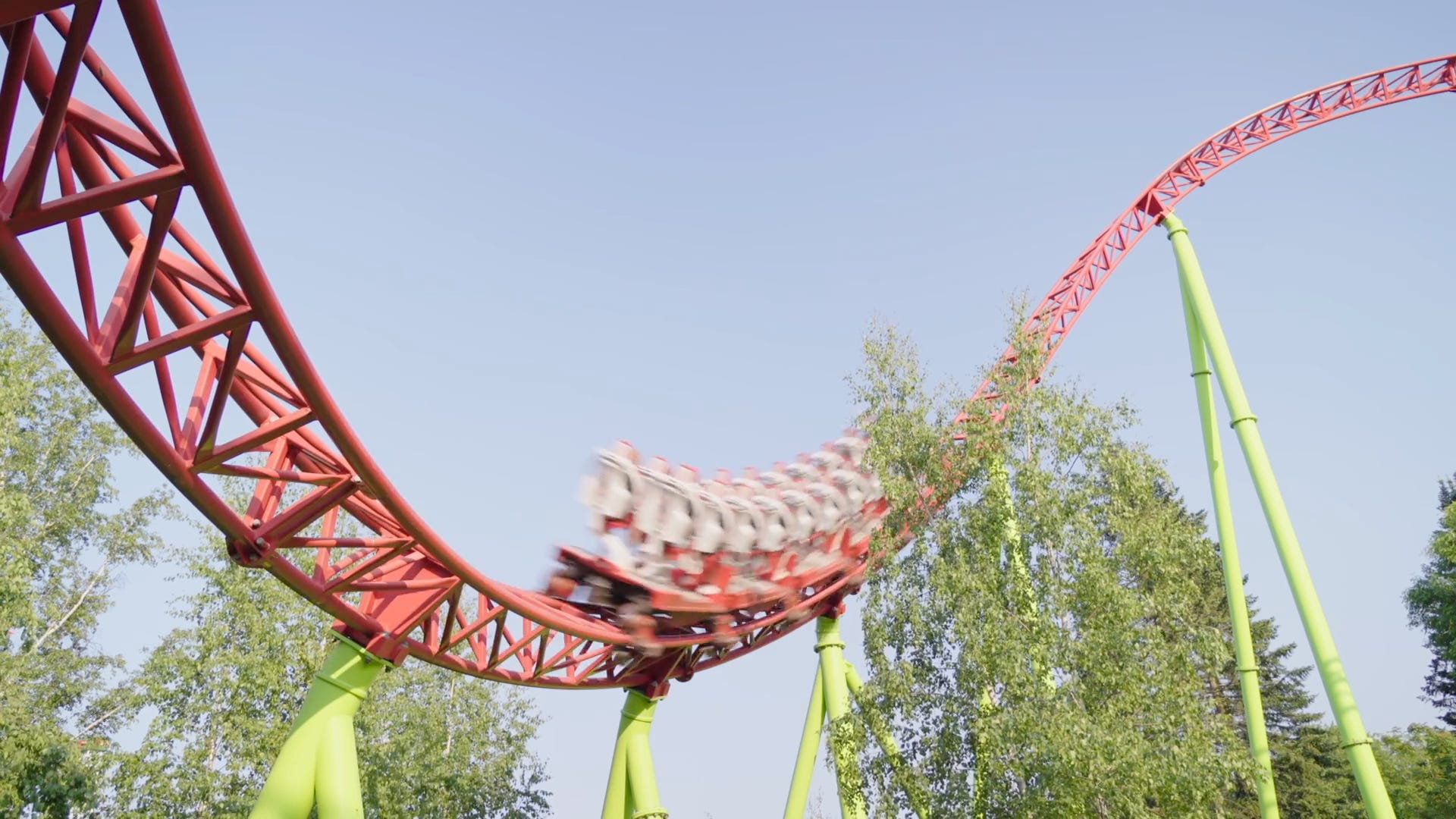
From roughly 1800-1990, what global economists call The Great Global Divergence, exploded civilization’s 10,000 year-old agriculture model (which had exploded the hunter-gatherer model). Half of humanity – the “Ancient” civilizations (China, India, Asia, Africa) – continued primarily growing food-stuffs for primarily subsistence-living populations. By 1800, the other half – Europe and America, and eventually Japan – had gotten an early jump on the science-innovation-industry “knowledge economy” – so, “mass-manufacturing,” “mass-marketing” all kinds of “stuff” to “supply-chained consumers.”
The Great Divergence’s opportunity set was shocking – from sails to steam to container ships to FEDEX and now SpaceX landing on barges in the ocean, from paper to digitization, from cowboys to astronauts, from subsistence poverty to an entirely new, and awesomely powerful, “middle class.” In just 200 years or eight generations!
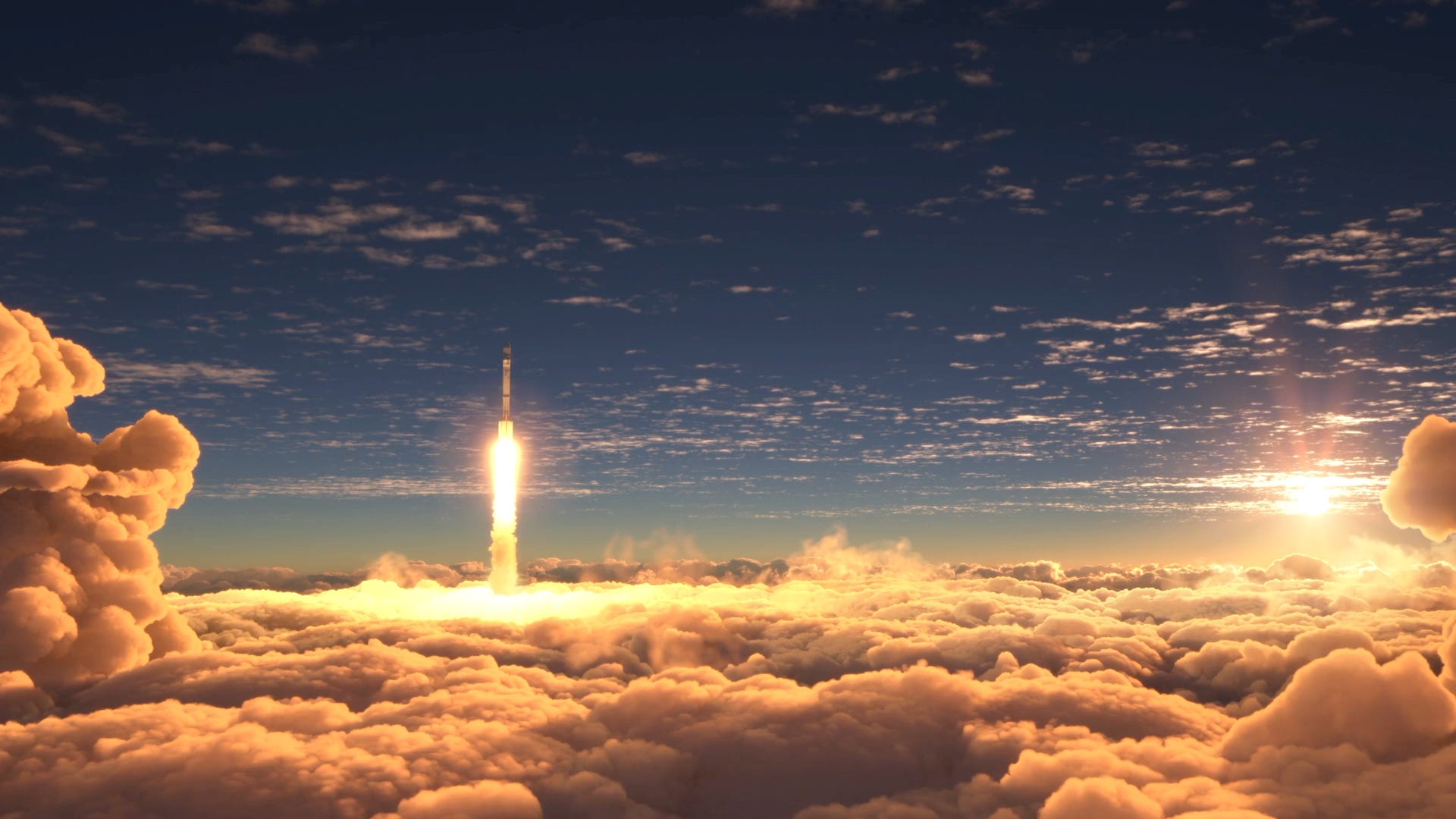
But the Great Divergence’s risk set was more shocking – native peoples overrun by the West’s colonizing “manifest destinies” and disease, by industrial-scale global warfare and holocausts in the fight over physical resources, from living a harsh, subsistence country life to an even harsher city life plagued by disease and pollution, from agrarian economies to outrageous global “Opium Wars” driven by “freedom of commerce,” or from 60 million magnificent bison freely roaming America’s Great Plains to their casual slaughter for “sport” in the name of “frontier progress.”
But were the Europeans just wretched people? Slavery and atrocities appear in every human civilization. Would the Asians or the Africans, or the Incas, or Navajo, how would they have ridden the knowledge-tech-industry wave if they had gotten to “modernity” first? Or did the Europeans just bring it with massive, industrial scale and power? If knowledge is economy, can the wreckage of the old, agrarian civilizations be at least in part explained by the disparity of knowledge resources? Or, possibly, is humanity really just desperately riding and trying to hang on to this big “knowledge” wave? Are we rather never fully prepared to live it and manage it with care and concern? How do we play on this quantumly entangled field?
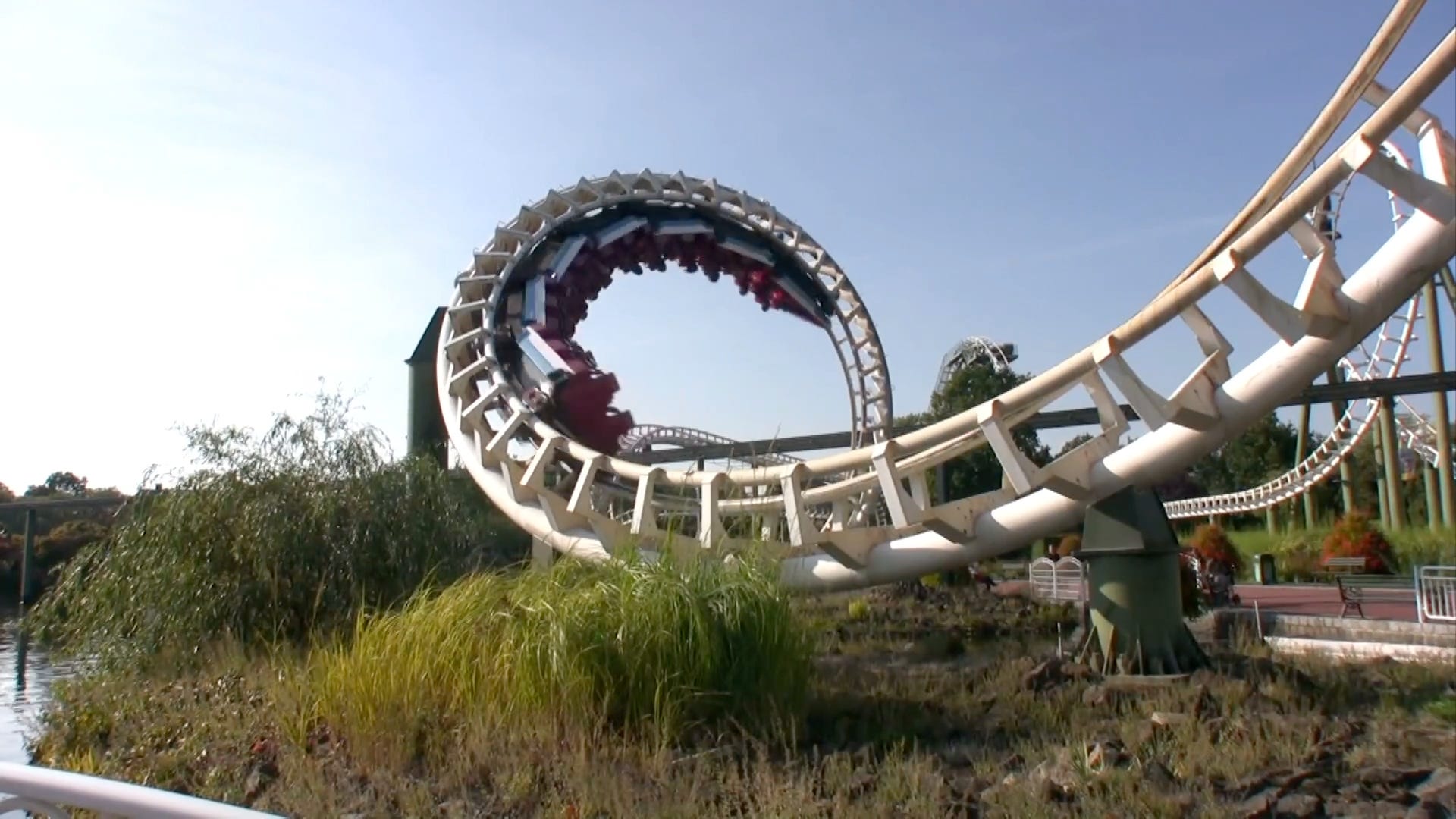
But then, hang on! Incredibly, the roller-coaster flipped again – the Great Divergence’s high-tech innovation exploded into The Greater Global Convergence. From roughly 1990-2020, the new Internet-connected tech economy discovered it could re-direct industry back to the ancient world, starting with China, to make all the gadgets, smartphones, T-shirts, pharma, etc., etc., etc.!
China was led by Deng Xiaoping, the Communist leader who had marched with Mao on the Long March, who Mao imprisoned, but who would survive to dine on Texas barbecue with U.S. president George W. Bush. Deng was a practical leader, a pragmatist – he’s famous for saying, “I don’t care if the cat is white or the cat is black if the cat can catch the mouse!” Deng was riding the big wave – he opened China’s workshops to modernity.
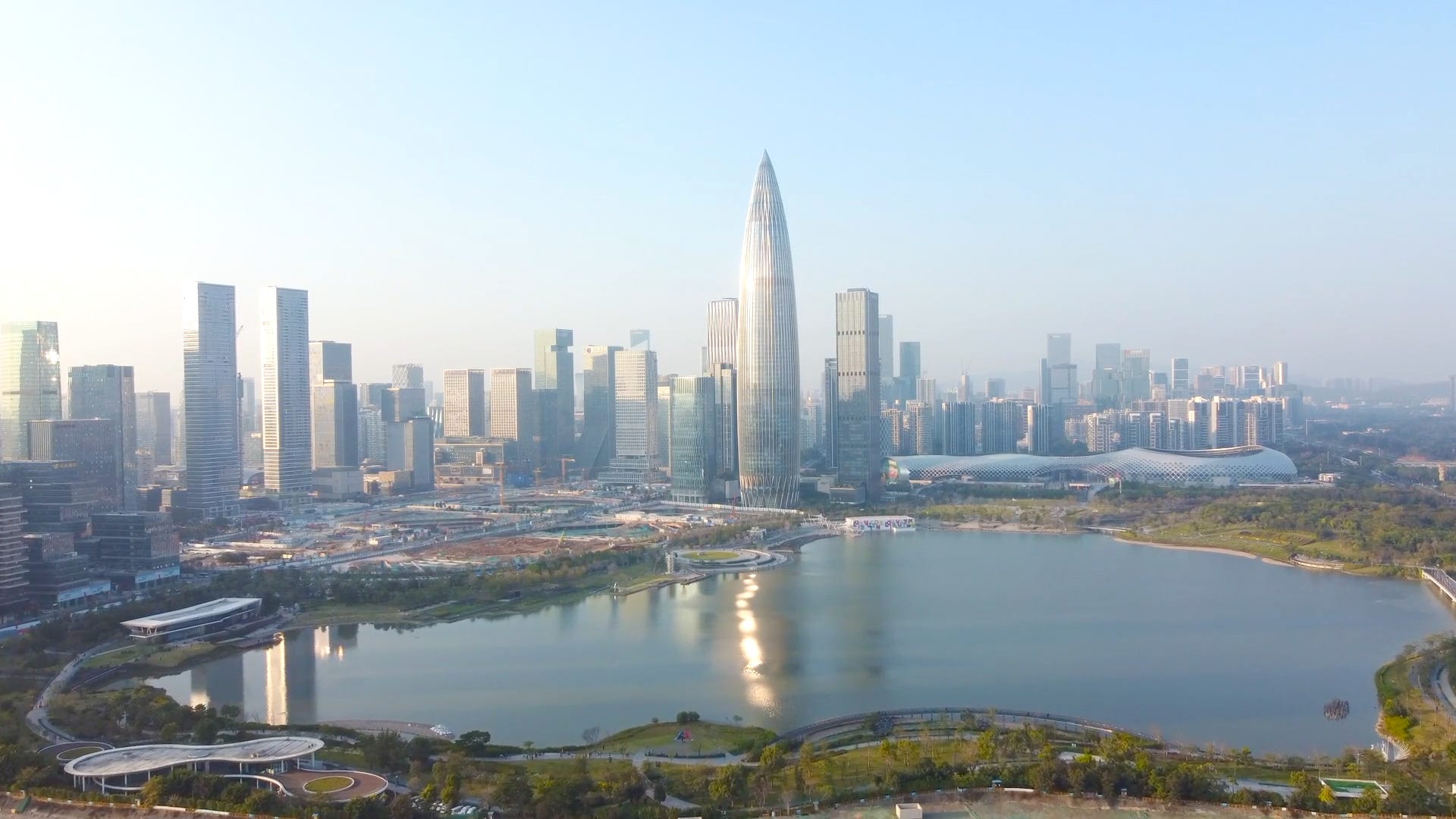
And it worked! China industrialized in thirty years – it had taken the West a hundred, or more. The Asian, agrarian-based side of the world leapt overnight from the family farm to modern cities.
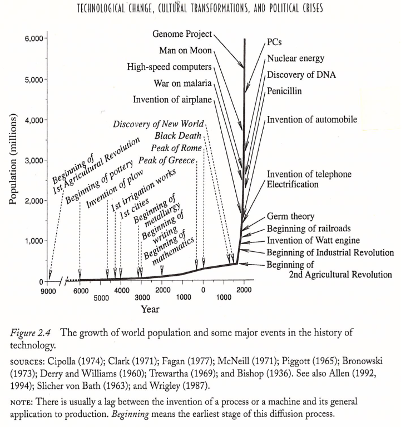
For better or worse the techno-industrial revolutions exploded populations and abundance, from 1 billion in 1800 to 6 billion by 2000 – imperfect, disrupting the planet’s ecologies, yet most every human was healthier, with more to eat, and living longer! Like it or not, it’s here. It’s Fogel’s big-wave, techno-physio-cultural evolution.
The Stealth Economy
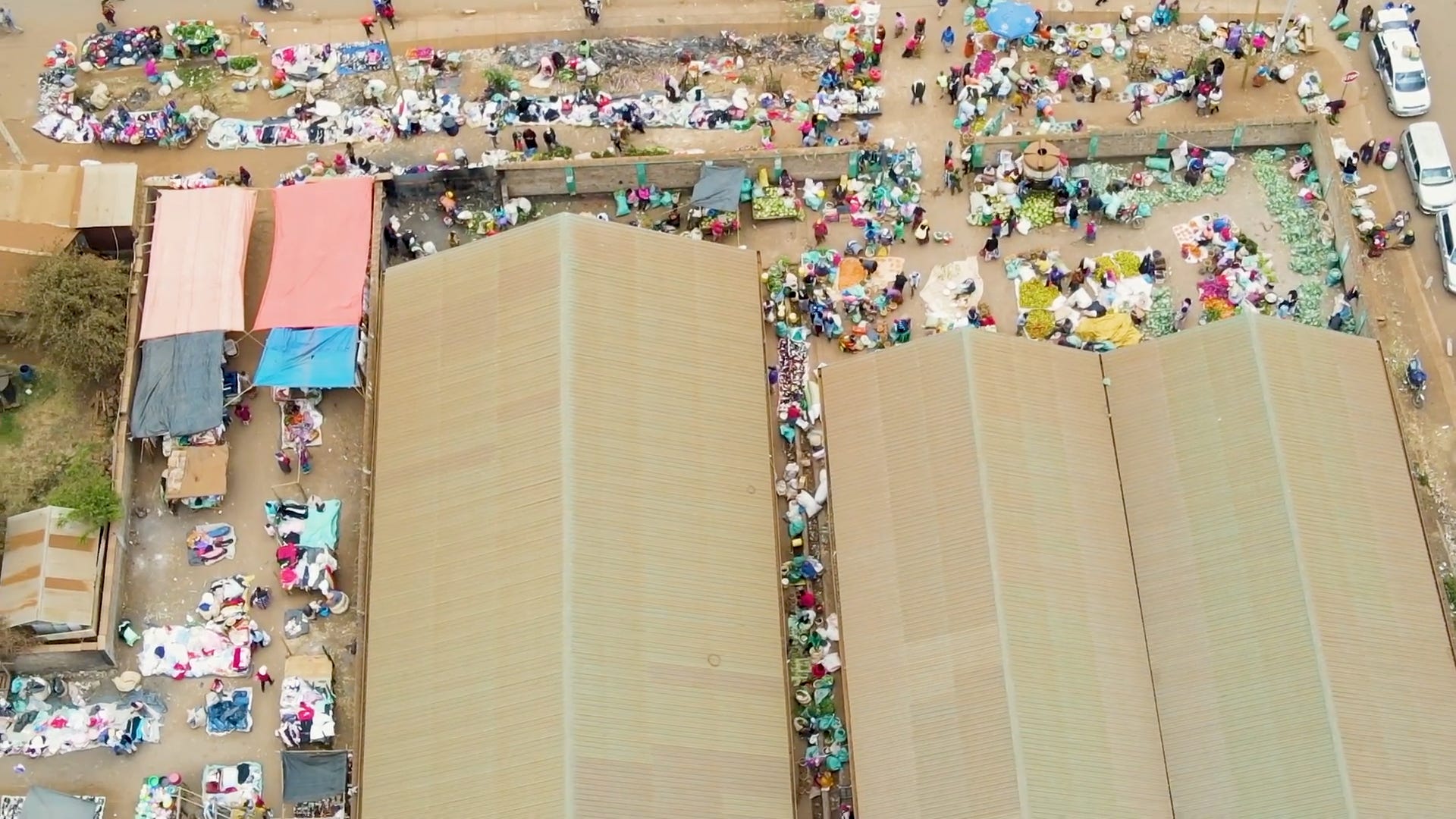
It’s getting even wilder! The 21st century roller-coaster is unloading one million riders every week into Earth’s 10,000 cities, mostly in Asia, Africa, and South America. It’s made possible partly by the 3rd Agricultural Revolution’s bountiful fertilizers and machines. Half the world’s “workers” and street-entrepreneurs live in this new stealth economy. They are spontaneously creating an alternative, “informal” version of the global market economy – they’re moving and selling goods and services largely outside of government taxation and control, setting up informal and hyper-local neighborhood governances and infrastructures right next door and within modern cities. According to Robert Neuwirth, if this globalized stealth economy were measured as a single nation, it would be the world’s second largest economy.
[i] Robert Neuwirth, Stealth of Nations
[i] Neuwirth, Robert, Stealth of Nations – the Global Rise of the Informal Economy, New York, Pantheon, 2011; see also Neuwirth’s TED Talks YouTube: https://www.ted.com/talks/robert_neuwirth_the_power_of_the_informal_economy?language=en
Robots…“A.I.”...The Roaring 21st Century
And now the roller-coaster is flying into…the CLOUD! – to “anytime/anywhere” artificial intelligence (“A.I.”).
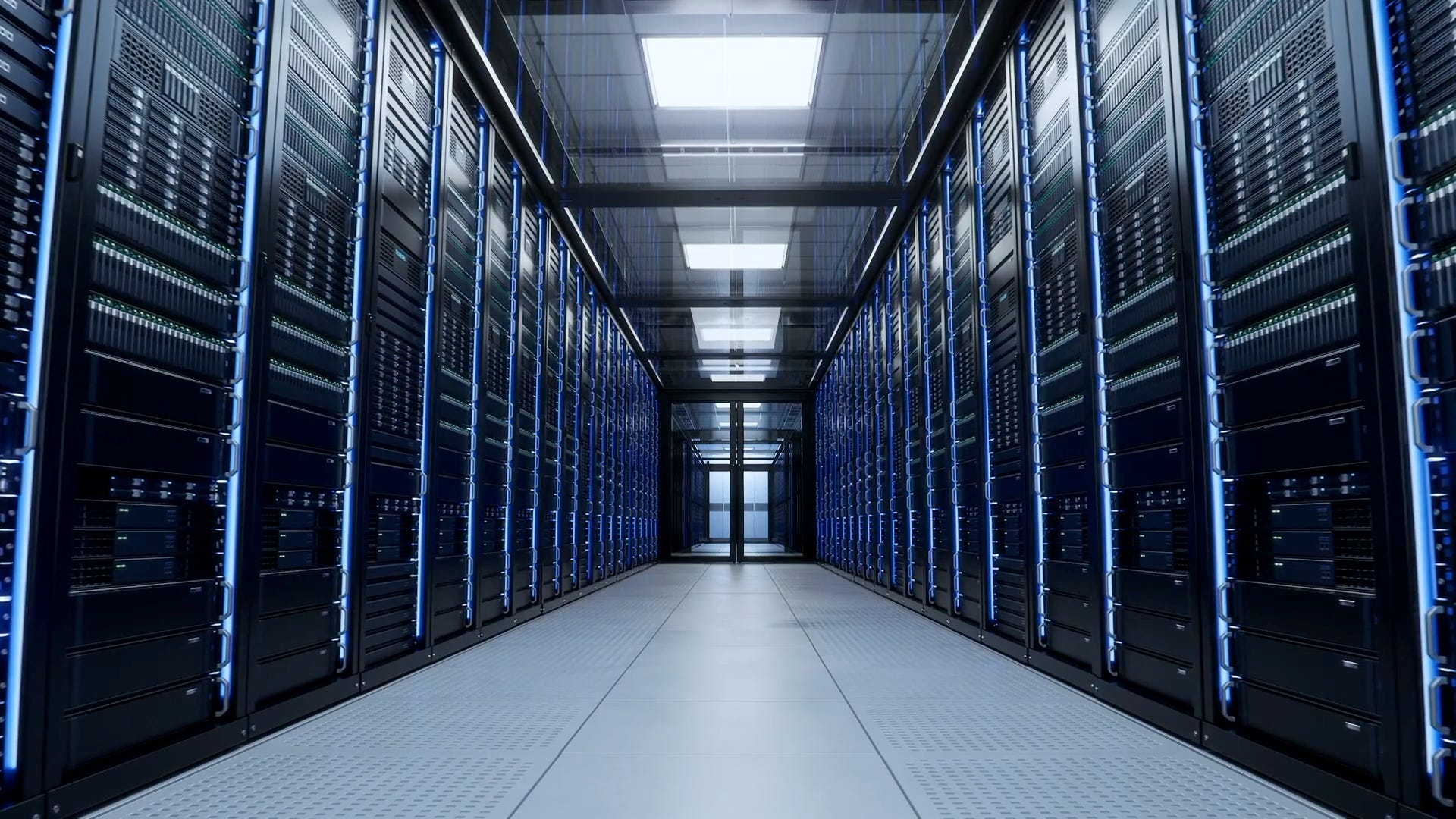
The home of economic power used to be the skyscraper – New York City’s Empire State Building was the first. Today it’s Dubai’s Burj Khalifa, soaring 2,700 feet (829 meters). However, A.I.’s Cloud is making skyscrapers obsolete. The 21st century’s heart and brain is the modern datacenter. The Burj houses
“100,000 bio-processors (humans) while a datacenter houses 100-200,000 silicon processors. Both cost roughly the same to build, but the datacenter rents for five times as much per square foot as the skyscraper….one of the largest datacenters is in Reno, Nevada, U.S.A.”
Mark Mills, The Cloud Revolution
Your smartphone lives in the Cloud’s datacenters.
SUMMARY – What’s Next?
The takeaway here is that Homo sapien evolution, now exploding out of this innovating, scientific, and globalizing civilization, has always advanced ahead of itself, and ahead of our ability to practically manage and ethically respond to it. We underestimate this at great peril to ourselves, our children, and Earth’s lifeworld. Underestimating the wild economy is to under-live its unconstrained power.
So what’s next?
In Wild Capital & Finance we’ll explore what “capital” really ever was, and what it is now that “knowledge” is the primary economic resource. And we’ll see how tech and knowledge games have crept into the 21st century economy and defy the human players who believe they can “guide” or “govern” it all.
In Wild Governance we’ll dig into how government is riding the phenomenal wealth wave and has evolved into massive bureaucracies that resist or hide from feed-back loops. To pay for it all they’ve created entirely new, overblown investment asset classes, namely unpaid and unpayable debts. How does that work? OR NOT! We’ll observe how governance everywhere has gotten bigger, bigger, and how this can only be explained on an evolutionary scale. Governance, with all its stately buildings and monuments, is wilder than ever!
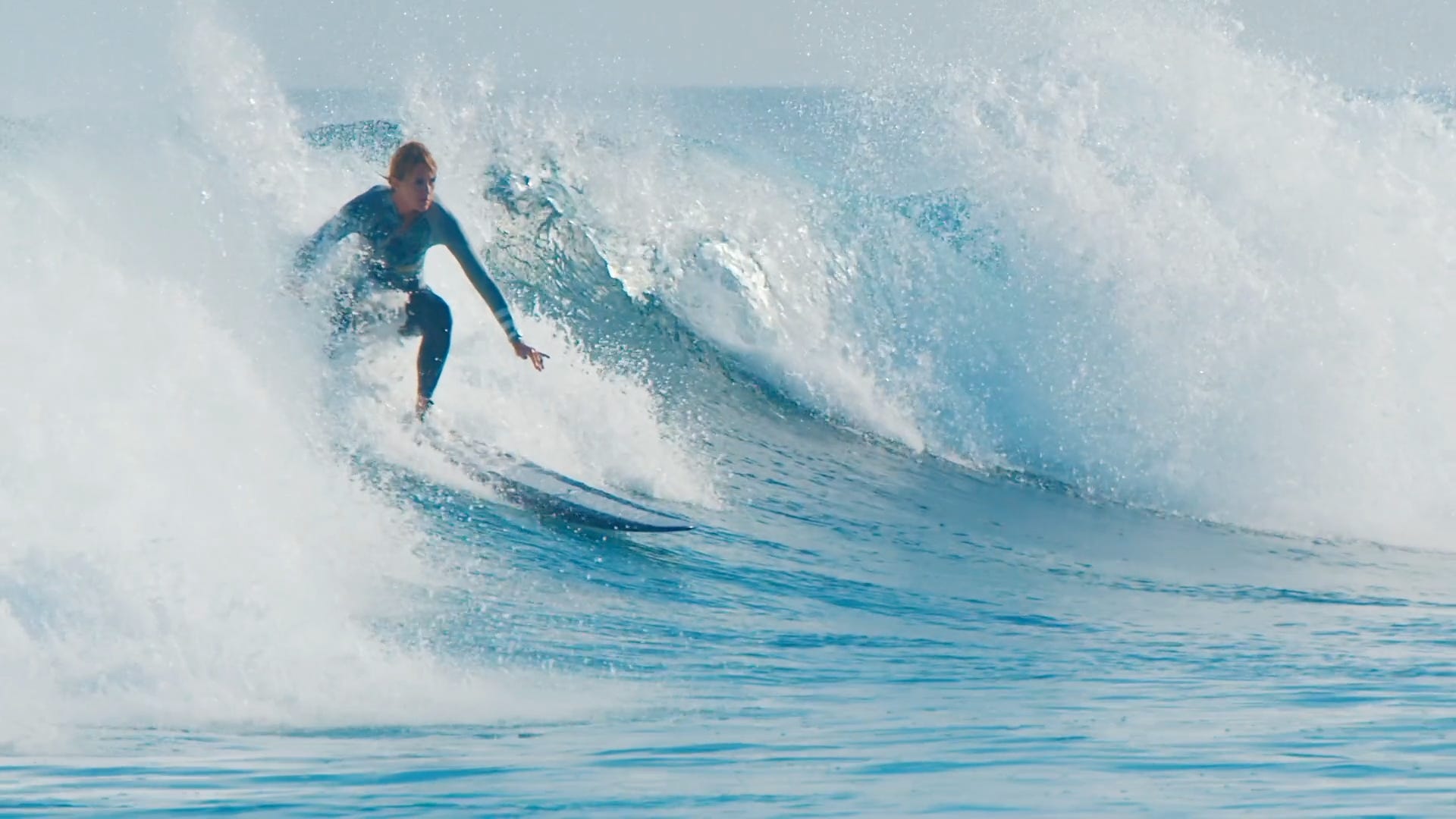
Finally, Wild Wealth in the 21st Century will introduce us to the challenge of investing and deploying our hard-earned capital into this wild ecology >> demographic >> tech >> economy >> governance big wave. How can our lives and investments surf the wild global quantum entanglement wave with both intelligence and care?
Stay tuned! And be careful – it’s wild and getting wilder out there